
What Is the H-3 Visa?
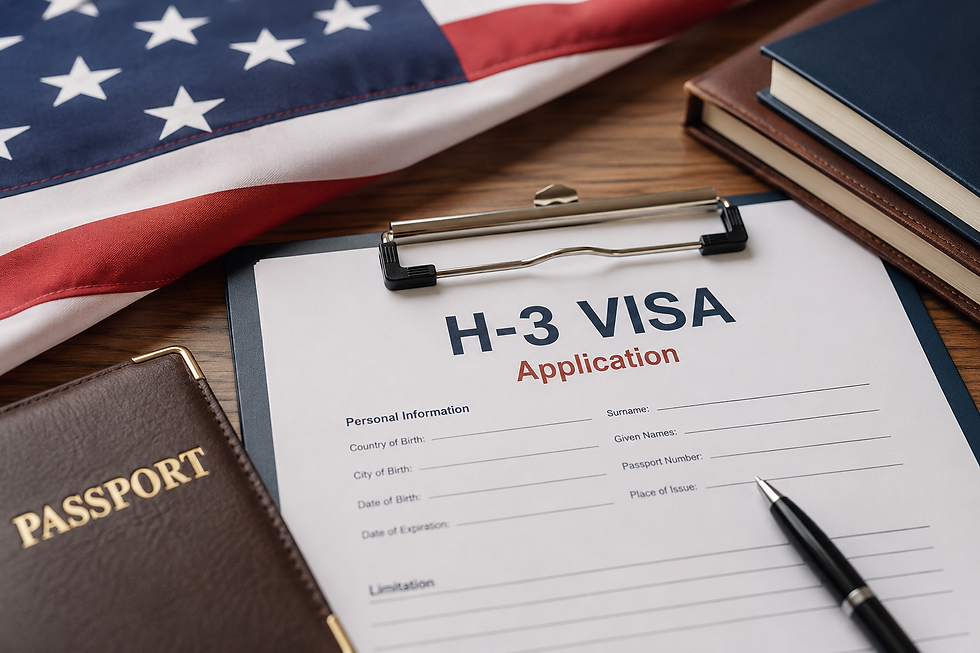
The H-3 visa is a specialized nonimmigrant visa category that allows foreign nationals to participate in training or internship programs in the United States that are not primarily for employment purposes. Through this visa, foreign nationals may benefit from professional training programs unavailable in their home countries and bring the knowledge and skills they acquire back home.
Caglar & Associates, PLLC, a New York-based immigration law firm, provides professional legal support at every stage of the H-3 process for U.S. organizations and companies offering training programs, as well as individual trainees.
Who Can Apply?
The following individuals may apply:
Foreign nationals seeking to receive professional training
Foreign national employees who will intern at U.S. companies
Professionals who will participate in training programs unavailable in their home countries
Individuals with disabilities to be included in special education programs
Individuals who will receive training in fields such as agriculture, commerce, finance, law, insurance, accounting, and engineering
Foreign national participants invited by a U.S. sponsor organization
Eligibility Requirements
A structured training program prepared by a U.S. organization or company must exist.
The program must not be primarily employment-oriented; it must be training-focused.
It must be documented that this training is unavailable in the applicant's home country.
The sponsor organization must submit an I-129 petition to USCIS.
The duration of the training program must not exceed two years.
The applicant must demonstrate intent to return to their home country upon program completion.
Application Process
The sponsor organization prepares a structured training program
Required documents are gathered and the I-129 petition is prepared
The petition is submitted to USCIS and approval is awaited
Following USCIS approval, the consular visa application is completed
Upon visa approval, entry into the United States is made and the training program begins
Required Documents
Valid passport
Detailed description of the structured training program
Sponsor organization's offer and invitation letter
Applicant's resume and educational documents
Documents demonstrating that the program is not employment-oriented
Evidence that this training is unavailable in the applicant's home country
I-129 petition (filed by the sponsor organization)
DS-160 online nonimmigrant visa application
Important Legal Points
The H-3 program must not be primarily productive employment in nature.
The application cannot be filed individually; a sponsor organization is required.
The training duration is limited to a maximum of two years and cannot be extended.
Following program completion, the individual must remain outside the United States for at least six months.
Working for a separate employer while in H-3 status constitutes a visa violation.
Incomplete or insufficient documentation may result in a Request for Evidence (RFE) from USCIS.
Frequently Asked Questions (FAQ)
What is the H-3 visa?
It is a specialized visa category that allows foreign nationals to participate in training or internship programs in the United States that are not primarily for employment purposes.
Can I work with an H-3 visa?
No. The H-3 visa is not for employment purposes; it is valid only within the scope of training and internship activities.
In which sectors can training be received?
Structured training programs in agriculture, commerce, finance, law, insurance, accounting, engineering, and similar fields fall within this scope.
Who files the application?
It is not possible to file the application individually. The process begins with the U.S. sponsor organization submitting an I-129 petition to USCIS.
Who can be a sponsor organization?
Any U.S. company, institution, or organization that offers a structured training program may serve as a sponsor.
How long can the training program last?
A maximum of two years. This period cannot be extended.
Can a new application be filed after two years?
The individual must remain outside the United States for at least six months after program completion. If this condition is met, a new program application may be considered.
How does the H-3 visa differ from H-1B?
H-1B is an employment-based work visa. H-3 is for training and internship programs that are not primarily employment in nature.
Can an H-3 visa holder receive a salary?
A limited stipend may be received as part of the training program; however, this should not be considered full employment in the true sense.
Is a consular interview required?
In most cases, yes. Different procedures may apply for nationals of certain countries.
Can family members come to the United States under H-3?
Yes. The spouse and dependent children under the age of 21 of an H-3 status holder may come to the United States on an H-4 visa.
Can H-4 family members work?
No. The H-4 visa does not grant work authorization.
Can the application be denied?
Yes. Insufficient program details, suspicions of employment intent, or incomplete documentation may result in a denial.
What is an RFE (Request for Evidence)?
It is when USCIS requests additional information or documentation when it finds a submission insufficient during the evaluation process. Receiving an RFE does not mean denial; however, responding in a timely and complete manner is critically important.
What can be done if the application is denied?
The grounds for denial should be reviewed and a plan for reapplication or appeal should be developed. Seeking legal support at this stage is strongly recommended.
Can the applicant leave the United States before the program is completed?
Yes; however, in this case the visa expires. A new application may be required to resume the program.
Can a transition to a different visa category be made from H-3 status?
Under certain conditions, yes; however, it requires careful legal evaluation.
Is the content of the training program important?
Yes. The program must be structured, have measurable objectives, and be genuinely training-focused. Insufficient content may result in denial or an RFE.
How is it proven that the training is unavailable in the home country?
Documents must be prepared showing that the applicant has researched training opportunities in their home country and that this program is offered exclusively in the United States.
Can the applicant work with more than one sponsor organization?
No. The H-3 visa is limited to a single sponsor organization. A change of sponsor requires a new petition process.
What happens if the sponsor organization changes?
A new I-129 petition must be submitted to USCIS on behalf of the new sponsor.
Is premium processing available?
Yes. USCIS offers premium processing for H-3 petitions, which can reduce the processing time to approximately 15 business days.
Is translation required?
Yes. All documents not originally in English must be translated by a certified translator.
How long does the process take?
Depending on USCIS standard processing times, it may range from a few weeks to several months. Premium processing can significantly reduce this timeframe.
Can the H-3 visa holder travel outside the United States and re-enter?
Yes. With a valid H-3 visa, travel abroad and re-entry into the United States are permitted, provided the training program is still active.
What happens if the sponsor organization closes or ceases operations?
If the sponsor organization closes, the legal basis for the H-3 status is eliminated. In this situation, transitioning to another appropriate visa category should be evaluated immediately with the support of legal counsel.
Can the H-3 visa be converted to an H-1B after the training program ends?
Under certain conditions, yes. If the applicant qualifies for H-1B after completing the training program and a U.S. employer is willing to sponsor the petition, transitioning to H-1B status may be possible. This process requires careful legal planning.
Does the training program need to be approved before the visa application?
Yes. USCIS must approve the I-129 petition — which includes the training program details — before the consular visa application can be completed.
Is legal counsel truly necessary?
Absolutely yes. The proper structuring and documentation of the training program in H-3 applications directly affects the outcome of the process. Professional legal guidance is critically important for both the sponsor organization and the individual applicant.
Contact Caglar & Associates, PLLC
Address: 100 Church St 8th Floor, New York, NY 10007, United States
Phone: +1 (646) 874-3575
Email: info@caglarpllc.com
Attorney Ibrahim Furkan Caglar
New York Bar Number: 6160303
Free Initial Consultation for the H-3 Visa
Contact us to evaluate the eligibility of your training program and explore your legal options.
Let's assess your case together.


